
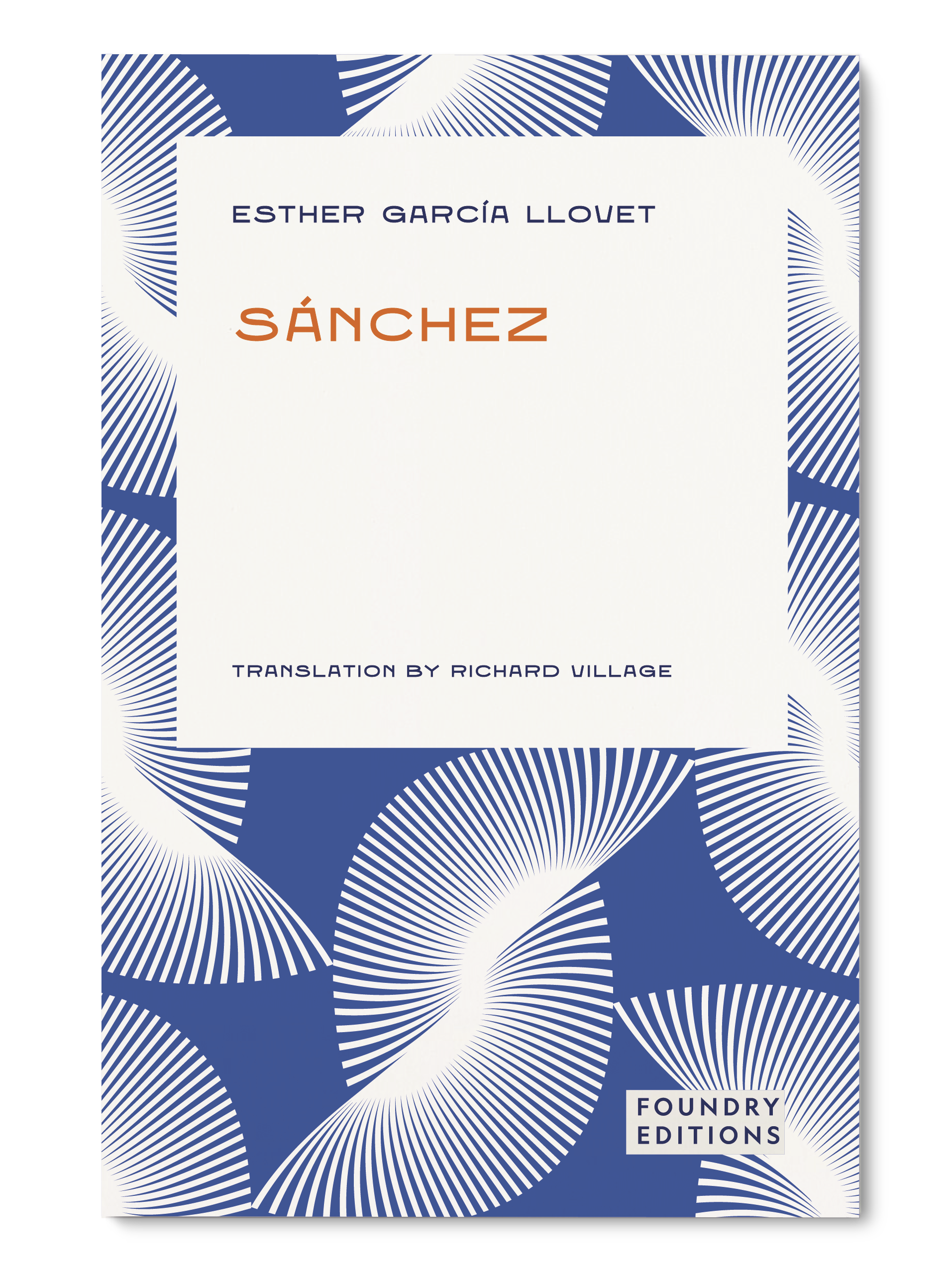
Esther García Llovet
SÁNCHEZ
Translated from Spanish by Richard Village
SPAIN
ISBN: 978-1-917544-00-9
One night in Madrid , two hapless chancers, and a greyhound called Cromwell.
One night in Madrid. The one the tourists, and plenty of Madrileños never see. The Madrid of poker games, scams and dodgy deals. Of flyovers, bus stations and industrial estates. Of gamblers, gangsters, and the odd saint, who might just perform a miracle. The Madrid of Sánchez and Nikki.
In her latest book, Esther García Llovet follows this not quite Bonnie & Clyde pair of chancers on the brink as they desperately hunt down a greyhound called Cromwell, who might just be the answer to all their problems. With her razor-sharp language, her inimitable eye for the absurd, and her surreal style, that feels like David Lynch after too much vermut, García Llovet reveals herself as a cinematic storyteller par excellence and an unrivalled, passionate portraitist of the Spanish capital and the characters who live in its shadows.
“This novel is a road movie, very traditionally Spanish, where the main characters desperately search, under the Madrid sky, for a piece of heaven that they’re never going to reach”
ESQUIRE
“Wonderful… Please don’t miss out on reading this book”
EL PAÍS
“Charming, beautiful, strange, tender, unsettling, this novella sticks with you and takes you on a journey as you chase or flee your dreams”
EL CULTURAL
“We like García Llovet a lot. We like her style, we like her poetics. A cult author.”
SARA MESA
AUTHOR
ESTHER GARCÍA LLOVET was born in Málaga in 1963. She moved to Madrid in 1970, where she studied clinical psychology and film direction and has lived ever since. She started writing in 2000 and has written eight novels, including the three novels of her acclaimed Snapshot Trilogy of Madrid (Anagrama). Her works have achieved critical success and cult status for their intense, cinematic style and offbeat Chandleresque realism. García Llovet writes for several different cultural anthologies and periodicals, as well as being a translator from English and a well-respected photographer.
TRANSLATOR
RICHARD VILLAGE is a London-based translator and editor working from Spanish and Italian into English. After a lifetime in marketing and branding, Richard went back to university to the MA programme in translation at the University of East Anglia. He is the founder of Foundry Editions.
PREVIEW:
Five kids under a streetlamp. Five deaf kids signing. Under the streetlamp because it was the only place they could see each other. In the dark they had no chance. In the dark there was absolutely nothing, nobody, no chance of chatting and hanging out. Deafening silence. Two in the morning. Everything’s easier than eating with your hands.
I recognised him from the other side of the street. He was in the same Bermuda shorts that looked like old curtains and he had the yellow reflector on his right shoe. I recognised him by the way he walked, by his fiesta swagger, like a handsome man who’d gone to seed, like Sánchez. I knew I was bound to find him here, by the vending machines, the only place to get food and drink at this time of night in this neighbourhood of office blocks. I watched him from the car. I’d parked on the pavement opposite and I’d been sitting there for ages, with the lights off and my feet on the dashboard.
He put in a coin. The machine swallowed it. Then he put in another one, then another, but the machine still gave him nothing in return. He didn’t seem bothered. He still had big hair, curly, like a vulture’s nest. After the fourth coin, the machine spat out a can. Sánchez leant his back against the icy surface of the glass, opened the ring pull and the sound echoed back over five long seconds from the five enormous Mayan temples of the Azca Complex.
I shouted.
“Sánchez.”
He turned round. I waved so he could see me. He took a long swig from the can whilst he looked at me; he didn’t move until he’d made up his mind then he came over, dragging his feet. He looked tired. It’s a thing these days, isn’t it? Being knackered and jumpy at the same time. Living with high blood pressure.
“You’ve got make-up on.” That was the first thing he said. Like he’d seen it all before.
“I’ve been at a party,” I said. I was still sitting in the driver’s seat. I didn’t want to get out of the car if I didn’t have to. “Some Colombians who are in town.”
“You never used to go to parties.”
“I’ve got make-up on because I’ve not slept for three days,” I lied.
“Not slept for three days, she says. Try five. Or a whole fortnight.” He was in a foul mood. His eyes were bloodshot, and he looked like he’d not had a shower for days. “A month. The nights go on, Nikki, on and on and on, it’s constant, noise from the fridge, noise from the street, it fucks me off, I feel it in bed, I hear cars and dogs and the girls down on the corner walking about, I even hear the filaments burning in the light bulbs.”
“Buy yourself an alarm clock. It’ll put you straight to sleep, I guarantee.”
“If I carry on like this, I’m going to end up doing smash and grabs at jewellers.”
He yawned. He took another swig from the can and swilled it around his mouth before swallowing.
“What are you up to these days?”
He didn’t answer me, just narrowed his eyes as if his mind was racing to come up with something to say. He could have looked properly sharp, like someone who’d walk into the sea in a cape. He had some money put away but in some moment of panic he’d decided he’d rather live as if every day was his last, at top speed, where everything real ended up going to shit.
“I rent out show flats.”
God, I love Madrid, I thought. We’re so good at making the most of leftovers. Off-cuts of meat, football stadiums. One day they’ll give us an international award for recycling, and we’ll see what we can turn that into.
“I’ll take you home,” I suggested.
“Which home.”
I opened the door so he could get in. He thought about it for a second or two. He looked both ways up the Castellana, at the zebra crossings on the Castellana, in rows one after the other, like a thousand lines of coke. He looked at the blurs of cars speeding past at this time of the morning. He got in. The seat was covered in bits of paper and notebooks and packets of cigarettes. I moved them to the back seat and found a dozen carefully stacked cardboard boxes. Sánchez threw the wrapper from his Twinkie on the floor and stuffed it down in one go.
He was still keeping himself going on plastic, on wrappers, on insulin spikes. He sat down next to me.
“Who’ve you nicked this heap of shit from?” he asked.
“Some deaf kid.”
